
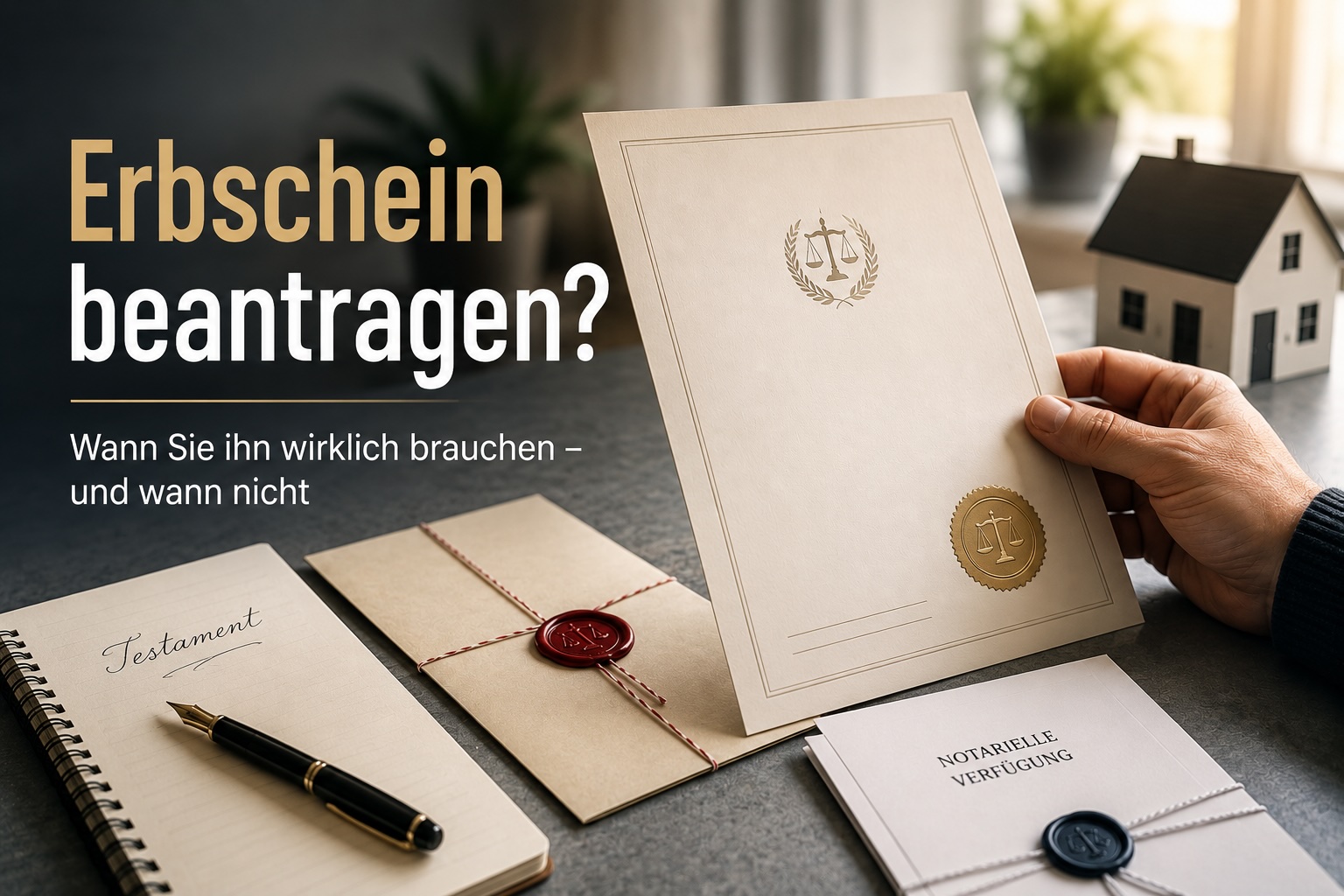
After a death, many matters need to be dealt with. Bank accounts must be clarified, contracts reviewed, insurance companies informed and, where applicable, real estate or other assets managed. Sooner or later, one question often arises: Do I need a certificate of inheritance?
Many heirs assume that a certificate of inheritance is always required before they can deal with the estate. However, this is not correct. A certificate of inheritance is an important document, but it is by no means necessary in every inheritance case. Anyone who applies for one too quickly may incur costs that could possibly have been avoided.
On the other hand, there are situations in which it is almost impossible to proceed without a certificate of inheritance. The decisive question is therefore not whether an heir “should have a certificate of inheritance”, but whether it is actually required in the specific case.
What Is a Certificate of Inheritance?
A certificate of inheritance is an official certificate issued by the probate court confirming the order of succession. It states who has become the heir and, where several people inherit, generally also specifies their respective shares.
Its main purpose is to provide proof of inheritance to third parties. Banks, insurance companies, public authorities, business partners and other institutions need to know whether a person is genuinely authorised to act on behalf of the estate.
However, it is important to understand that a certificate of inheritance does not make someone an heir.
A person becomes an heir either under the statutory order of succession or on the basis of a valid disposition upon death, especially a will or an inheritance contract. In principle, the legal position as heir arises immediately upon the death of the deceased. The certificate of inheritance merely documents this legal position and establishes the statutory presumption that the person named in it as heir holds the inheritance right stated in the certificate.
It is therefore an important document of legitimisation, but it is not the legal basis of the inheritance itself.
Why Many Heirs Automatically Think They Need a Certificate of Inheritance
The assumption is understandable. Anyone who needs to prove to a bank, the land registry or another institution that they are an heir requires reliable evidence. A certificate of inheritance therefore appears to be the obvious solution.
However, it is only one possible way of proving heirship.
Depending on how the estate was arranged and which institution requires the proof, other documents may also be sufficient. Before submitting an application, it should therefore first be examined which documents are already available and for which specific purpose proof of inheritance is required.
This is because the requirements are not the same in every situation.
When a Certificate of Inheritance Is Often Not Required
Whether a certificate of inheritance is needed depends primarily on the legal basis of the succession and on the institution to which the heir must provide proof.
If a notarised will or a notarised inheritance contract exists, the succession can often be proven by presenting that testamentary document together with the court record confirming its official opening. In many cases, an additional certificate of inheritance is then not required.
This applies in particular to corrections to the land register. Under Section 35(1) of the German Land Register Code (GBO), succession may generally be proven to the land registry by means of a disposition upon death contained in a public document, especially a notarised will or inheritance contract, together with the official record of its opening.
A purely handwritten private will, on the other hand, is generally not sufficient for this simplified form of proof before the land registry. If the estate includes real estate and succession is based solely on a handwritten will, a certificate of inheritance may therefore still be required to correct the land register.
The situation may be different when dealing with banks and other institutions. A handwritten will does not automatically mean that a certificate of inheritance is always required. If the succession is clearly established by an officially opened private will, that will, together with the court record of its opening, may be sufficient proof of inheritance.
The German Federal Court of Justice has clarified that a bank may not insist on a certificate of inheritance solely on the basis of abstract doubts if heirship can be clearly proven by an officially opened handwritten will.
Whether the available documents are sufficient always depends on the specific circumstances and on the institution before which proof must be provided.
The general rule is therefore: Do not apply for a certificate of inheritance too quickly. First determine which proof is actually required for the specific purpose.
May Banks Always Demand a Certificate of Inheritance?
Bank accounts are a frequent source of uncertainty. Some heirs are told by a bank that they must provide a certificate of inheritance even though a will already exists.
However, a bank may not automatically insist on a certificate of inheritance in every case. If heirship can be clearly proven through other suitable documents, an additional certificate may be unnecessary.
This can also apply to a handwritten will. The German Federal Court of Justice has ruled that an officially opened private will may be sufficient proof of heirship for a bank if the order of succession is clearly evident from it.
The specific circumstances remain decisive. If the succession is unclear, the will contains wording that requires interpretation, or there are specific doubts about the will’s validity or the identity of the heir, a certificate of inheritance may be required.
This demonstrates why the question cannot be answered according to a rigid formula.
A statement such as “the bank requires a certificate of inheritance” should therefore not automatically end the matter. It should first be examined whether the documents already available provide sufficient proof of heirship.
When Is a Certificate of Inheritance Actually Required?
A certificate of inheritance becomes particularly important where heirship cannot be proven sufficiently in another way.
This may be the case, for example, where no will or inheritance contract exists and the statutory order of succession therefore applies. In that situation, civil status documents may be needed to establish and prove who became the heir.
Certificate proceedings may also be necessary where wills are unclear or contradictory. The same applies where several testamentary documents exist and it must first be determined which one is legally decisive.
Typical situations include:
- There is no will or inheritance contract, and the statutory succession must be proven.
- A handwritten will does not clearly identify the heir or heirs.
- Several wills contradict one another or raise questions of interpretation.
- The validity of a will is disputed.
- Heirship cannot be proven sufficiently to an institution by any other means.
- There are complex family relationships or a large community of heirs.
- No suitable public testamentary document exists for correcting the land register, and the required proof cannot be provided through another legally recognised method.
In such cases, the certificate of inheritance is much more than a formality. The probate court must examine which order of succession actually applies.
How Much Does a Certificate of Inheritance Cost?
The cost of a certificate of inheritance is generally based on the value of the estate. The relevant amount is the procedural value of the certificate proceedings, which is normally determined by reference to the value of the estate.
In simplified terms: the higher the relevant value of the estate, the higher the fees may be.
In addition to the fee for the certificate proceedings, further costs may arise. The procedure normally requires a sworn declaration, for which a separate fee is also charged.
For a modest estate, the costs may still appear relatively limited. However, where the estate includes real estate, business assets or substantial investments, the costs may become significant.
This is exactly why an unnecessary certificate of inheritance can become a genuine cost trap.
Anyone who already has sufficient proof of inheritance but nevertheless applies for a certificate may end up paying for a document that was not actually required for administering the estate.
This does not mean that a certificate of inheritance should always be avoided. Where it is needed, it performs an important function. The point is simply that it should not be requested automatically and without first checking whether it is necessary.
The Application Is More Than Just a Form
An application for a certificate of inheritance is not merely a non-binding enquiry submitted to the probate court.
The applicant must explain the legal basis on which the claimed inheritance right is founded. Information about the succession must be provided, including family relationships, existing wills or inheritance contracts and other persons who might also qualify as heirs.
Depending on the case, these statements must be supported by official documents and other evidence. A sworn declaration is also normally required.
This is especially important where the succession is not clear.
For example, a person who believes they are the sole heir, even though a will may be interpreted in different ways, should not act too quickly. The same applies where several wills exist, wording is unclear, possible grounds for challenging the will are present or there is a family dispute.
In such situations, it should first be clarified who has actually become the heir before applying for a particular certificate of inheritance.
What Happens If the Certificate of Inheritance Is Incorrect?
Even an issued certificate of inheritance is not permanently immune from challenge.
If it is later established that the succession stated in the certificate does not correspond to the true legal position, the certificate is incorrect and may be withdrawn by the probate court.
This may happen, for example, if another will is found later, if a testamentary disposition is declared invalid or if it becomes apparent that the disposition must be interpreted differently.
By that time, however, decisions may already have been made. Bank accounts may have been closed, assets transferred or estate property sold.
The certificate of inheritance has special significance in legal transactions. The law creates a presumption that the inheritance right stated in the certificate is correct and, under certain conditions, also protects good-faith third parties who rely on its contents.
The legal consequences of an incorrect certificate of inheritance can therefore be complex.
For this reason as well, an application in a case involving unclear succession should not be treated as a mere administrative formality.
Several Heirs: Which Certificate of Inheritance Is the Right One?
If there are several heirs, a community of heirs is created. In that situation, the question also arises as to which form of proof is actually required.
A joint certificate of inheritance can identify all co-heirs and their respective inheritance shares. Alternatively, an individual co-heir may generally apply for a partial certificate of inheritance that confirms only that person’s status as heir and their share of the estate.
Which option is appropriate depends on the purpose for which proof is required and on how the community of heirs is organised.
Not every co-heir automatically needs a separate certificate, and a joint certificate is not the only appropriate solution in every case.
Before submitting an application, it should be clarified which form of proof is actually required for the intended purpose.
Where Is the Certificate of Inheritance Requested?
The competent authority is generally the probate court. This is normally the local court in whose district the deceased had their last habitual residence at the time of death.
The application may be submitted directly to the probate court. Alternatively, the necessary declarations may be formally recorded by a notary.
The required documents depend on the individual inheritance case. They may include, for example:
- death certificates,
- birth and marriage certificates,
- wills or inheritance contracts,
- court records confirming the opening of testamentary documents,
- evidence of family relationships, and
- information about other possible heirs.
Where the statutory order of succession applies, obtaining the required civil status documents may represent a significant part of the procedure.
In international inheritance cases, complex family relationships or cases involving several possible testamentary documents, the examination may be considerably more extensive.
Check First, Apply Afterwards
After a death, it is understandable that relatives want to deal with the necessary formalities as quickly as possible. However, when it comes to a certificate of inheritance, speed is not always the best approach.
Before submitting an application, three questions should first be answered:
- How is the succession actually regulated?
- Which documents are already available?
- For what specific purpose is proof of inheritance required?
Only after answering these questions can it be assessed properly whether a certificate of inheritance is necessary.
Sometimes it is indispensable. Sometimes it makes the administration of a complicated estate significantly easier. In other cases, it merely creates additional costs even though heirship can already be proven sufficiently by other means.
Particular attention should be paid to the institution before which proof must be provided. The requirements of a bank are not automatically the same as those of the land registry.
An officially opened handwritten will may, in certain circumstances, be sufficient proof of inheritance for a bank. By contrast, special statutory requirements apply to correcting the land register. A privately written will generally cannot replace a certificate of inheritance in the same way as a public testamentary document.
Conclusion: A Certificate of Inheritance Is Important – but Not Automatic
A certificate of inheritance is one of the most important instruments in German inheritance law. It provides clarity as to who may act as heir in dealings with third parties.
However, not every heir automatically needs one.
Anyone who has a notarised will or inheritance contract can often prove heirship by presenting the testamentary document together with the court record of its official opening. This may also be particularly relevant for correcting the land register.
In the case of a handwritten will, however, a more careful distinction must be made. An officially opened private will may be sufficient for banks and other institutions if the order of succession is clearly apparent from it. Stricter requirements apply to proof of succession before the land registry. A purely handwritten will generally does not replace a certificate of inheritance for that purpose.
A certificate of inheritance should therefore not be requested in advance or “just to be safe” without first checking whether it is actually required for the specific purpose.
Especially in the case of larger estates, an unnecessary certificate can result in substantial costs. Where the succession is unclear, a premature application may also raise legal questions that go far beyond a simple formality.
The most sensible sequence is therefore:
Clarify the order of succession. Review the available documents. Identify the specific need for proof. Only then decide whether a certificate of inheritance should be requested.