
Table of contents
Anticipated succession is considered one of the most important instruments of asset succession. Through lifetime transfers, tax allowances can be used multiple times, assets can be optimised for tax purposes and family structures can be organised at an early stage.
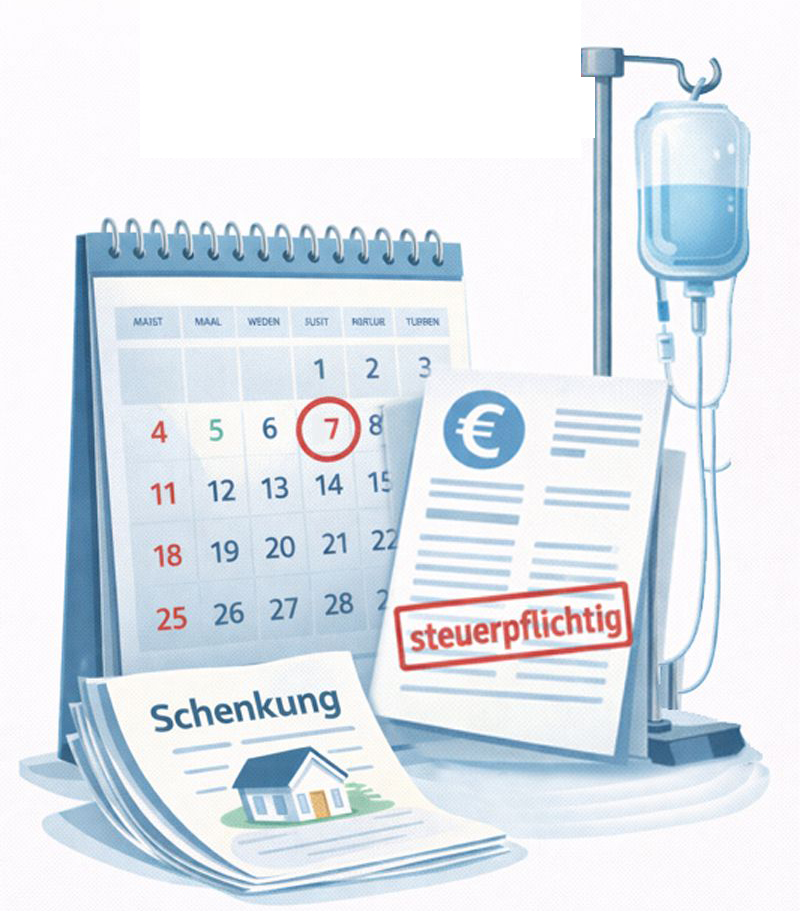
In theory, this is a proven planning tool. In practice, however, one crucial factor is often underestimated: the timing. This is because tax law is not based on intentions, but on cut-off dates.
German inheritance and gift tax law treats gifts and inheritance systematically in a similar way. Allowances apply to both lifetime transfers and acquisitions due to death.
A key advantage of gifts is that personal allowances can be reused every ten years. Those who transfer assets early on can pass on their wealth gradually in a tax-optimised manner. But this is precisely where the problem begins.
Gifts made within ten years of the inheritance are taken into account in the subsequent inheritance tax assessment.
This means that:
If the donor dies shortly after a large transfer, the intended tax advantage is lost. What was planned as a relief suddenly has the effect of increasing progression.
A recurring pattern emerges in consultations:
The gift is only made when:
At this moment, three factors collide:
However, tax law does not recognise a grace period.
It only takes objective time periods into account – not personal circumstances.
Another aspect is often overlooked: different valuation reporting dates apply to gifts and inheritances. Especially in the case of real estate or company shareholdings, increases in value within a short period of time can have a significant tax impact.
If, for example, a property is transferred and its value increases between the gift and the subsequent inheritance, different valuation mechanisms can affect the overall tax burden. Uncoordinated multiple transfers exacerbate this risk.
The combination of gift and reserved usufruct is popular. This reduces the taxable value, as the right of use reduces the capital value of the transfer. However, these models only have their full tax effect if there is a sufficient time gap between the gift and the inheritance. If the transfer takes place very late, the advantage may be less than calculated – especially if the remaining life expectancy is shortened.
The following burdens often arise in parallel with gifts:
If assets are transferred early, there may be a lack of liquidity for unexpected life situations. A purely tax-driven decision can thus become economically risky.
Anticipated succession is not an emergency measure. It is a strategic instrument that only works if there is sufficient time. Those who only make arrangements when illness or old age dominate run the risk that:
It is not illness or age that should determine the tax deadline, but forward planning. Successful asset transfer is a long-term structural process, not a spontaneous reaction to life circumstances. Anticipated succession works, but only if it begins in good time.
Dieser Ratgeber hilft Ihnen direkt Fehler zu vermeiden
Felder mit einem * sind Pflichtfelder